

Thank you for Subscribing to Eldercare Review Weekly Brief

Alberta Health Services
Michelle Parai Podmore, Director, Specialty Programs, Continuing Care Edmonton Zone
From Frontline Care to System Impact

Michelle Parai Podmore
As an occupational therapist, Michelle Parai Podmore started her healthcare journey on the front lines, where she first witnessed the power of compassion in care. Over two decades, she’s become a visionary leader, championing inclusive and patient-centered programs across Alberta’s continuing care system. Guided by empathy and a deep understanding of people and policy, she’s shaping a future where healthcare is adequate and deeply felt.
 Grounding Strategy in Compassionate Care
The strength of any healthcare system is revealed in moments of vulnerability. Podmore has spent over two decades observing those moments up close. Starting her career as an occupational therapist in the late 1990s, she learned that care is never just about treatment. It’s about trust, timing and the ability to meet people where they are, especially those with the least ability to ask.
That frontline perspective remains central to her thinking about leadership. Whether navigating operational demands or shaping long-term service delivery, she views strategy through the lens of lived experience—patients in transition, families in distress and care providers balancing compassion with complexity.
Seeing the Whole System and the Gaps within It
Over the years, Podmore has recognized that good care often breaks down in the space between disciplines during transitions, handoffs or shifts in eligibility. Her leadership evolved in response to these gaps, focusing on building systems that don’t just deliver services, but connect them.
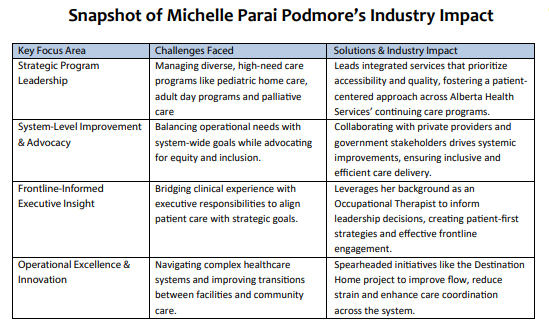
As she progressed into senior roles, she began rethinking how continuing care could function not as a fragmented patchwork of services, but as an integrated experience spanning pediatric home care, adult day programs and end-of-life support. A leadership style built on alignment emerged: between operations and empathy, policy and practice and individual needs and system goals.
Her ability to turn strategic oversight into practical change has reshaped how teams coordinate, how services scale and how vulnerable populations experience care.
Leading Through Complexity with Clarity and Conviction
Healthcare doesn’t offer perfect conditions. Decisions must be made quickly, often with incomplete information and the weight of those decisions ripples across patients, families and providers. In these environments, Podmore brings consistency, grounded in fairness, humility and clarity of intent.
She has refined an approach that values collaboration over control and continuous improvement over static plans. Rather than react to pressure, she helps teams create room to think, translating complex issues into simple questions—Is this helping the patient? Are we improving equity? Does the system move more smoothly because of this?
Her role in shaping provincial initiatives such as Destination Home reflects this systems-first thinking. By streamlining transitions between hospitals and communities, she helped create models prioritizing continuity and respecting people’s desire to heal in their own space.
Building for What Healthcare Should Become
Podmore doesn’t see healthcare leadership as a title—it’s a responsibility to design what comes next. In her view, the future lies in efficient and deeply human systems: flexible enough to meet unique patient needs and resilient enough to sustain caregivers through change.
From advancing palliative care to scaling pediatric home services, she focuses on creating structures that can adapt without losing their values. She believes the best systems are those where inclusion isn’t a goal—it’s a given. Her work continues to blend strategic foresight with emotional intelligence, shaping healthcare models that prepare for tomorrow without compromising the compassion required today.
Grounding Strategy in Compassionate Care
The strength of any healthcare system is revealed in moments of vulnerability. Podmore has spent over two decades observing those moments up close. Starting her career as an occupational therapist in the late 1990s, she learned that care is never just about treatment. It’s about trust, timing and the ability to meet people where they are, especially those with the least ability to ask.
That frontline perspective remains central to her thinking about leadership. Whether navigating operational demands or shaping long-term service delivery, she views strategy through the lens of lived experience—patients in transition, families in distress and care providers balancing compassion with complexity.
Seeing the Whole System and the Gaps within It
Over the years, Podmore has recognized that good care often breaks down in the space between disciplines during transitions, handoffs or shifts in eligibility. Her leadership evolved in response to these gaps, focusing on building systems that don’t just deliver services, but connect them.
As she progressed into senior roles, she began rethinking how continuing care could function not as a fragmented patchwork of services, but as an integrated experience spanning pediatric home care, adult day programs and end-of-life support. A leadership style built on alignment emerged: between operations and empathy, policy and practice and individual needs and system goals.
Her ability to turn strategic oversight into practical change has reshaped how teams coordinate, how services scale and how vulnerable populations experience care.
Leading Through Complexity with Clarity and Conviction
Healthcare doesn’t offer perfect conditions. Decisions must be made quickly, often with incomplete information and the weight of those decisions ripples across patients, families and providers. In these environments, Podmore brings consistency, grounded in fairness, humility and clarity of intent.
She has refined an approach that values collaboration over control and continuous improvement over static plans. Rather than react to pressure, she helps teams create room to think, translating complex issues into simple questions—Is this helping the patient? Are we improving equity? Does the system move more smoothly because of this?
Her role in shaping provincial initiatives such as Destination Home reflects this systems-first thinking. By streamlining transitions between hospitals and communities, she helped create models prioritizing continuity and respecting people’s desire to heal in their own space.
Building for What Healthcare Should Become
Podmore doesn’t see healthcare leadership as a title—it’s a responsibility to design what comes next. In her view, the future lies in efficient and deeply human systems: flexible enough to meet unique patient needs and resilient enough to sustain caregivers through change.
From advancing palliative care to scaling pediatric home services, she focuses on creating structures that can adapt without losing their values. She believes the best systems are those where inclusion isn’t a goal—it’s a given. Her work continues to blend strategic foresight with emotional intelligence, shaping healthcare models that prepare for tomorrow without compromising the compassion required today.The articles from these contributors are based on their personal expertise and viewpoints, and do not necessarily reflect the opinions of their employers or affiliated organizations.
